Sugar Reset Ingredients: What Is in Each Serving
Sugar Reset contains chromium plus a 200 mg blend of 22 plants and amino acids.
Chromium has its own line at 0.7 mcg (2% DV). The blend lists maca first and L-carnitine last, with no single amounts, and includes guarana and green tea (caffeine), grapefruit extract and a licorice compound.
For the full panel, read the Supplement Facts line by line.
How is the Sugar Reset label built?
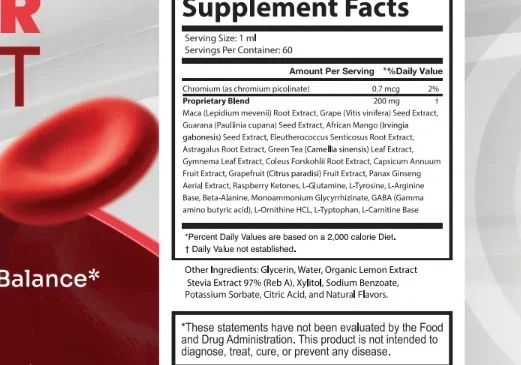
The label has two ingredient lines, and they work differently. Chromium (as chromium picolinate) gets its own row: 0.7 mcg, 2% of the Daily Value, the only ingredient on this bottle with a published amount.
Everything else, 22 names, sits inside one 200 mg Proprietary Blend, marked with a dagger for "Daily Value not established." US rules only require blend ingredients listed in descending order by weight, so maca, listed first, is the largest share and L-carnitine, listed last, is the smallest. No milligram figure is given for any single one.
Full panel transcription: Sugar Reset Supplement Facts. This page goes ingredient by ingredient.
Six named on the sales page, twenty-two on the label
Named on the sales page
- Chromium Picolinate
- Gymnema Leaf Extract
- African Mango Seed Extract
- Green Tea Leaf Extract
- Maca Root Extract
- Panax Ginseng Aerial Extract
Listed on the label
The six above (chromium has its own line) plus these, all inside the same 200 mg blend:
- Grape Seed Extract
- Guarana Seed Extract
- Eleuthero Root Extract
- Astragalus Root Extract
- Coleus Forskohlii Root Extract
- Capsicum Annuum Fruit Extract
- Grapefruit Fruit Extract
- Raspberry Ketones
- L-Glutamine
- L-Tyrosine
- L-Arginine Base
- Beta-Alanine
- Monoammonium Glycyrrhizinate
- GABA (gamma-aminobutyric acid)
- L-Ornithine HCL
- L-Tryptophan
- L-Carnitine Base
Sixteen more names share the same 200 mg total, including grapefruit extract and a licorice compound, neither of which appears in the sales page's own summary.
The six ingredients with published research
Chromium and the five plants the sales page names are also the ones with the most human research behind them. Tap through for the research dose, the evidence level and a safety note on each.
Chromium (as chromium picolinate)
chromium picolinate · trace mineral
The only ingredient with its own printed amount, and it is tiny: 0.7 micrograms. NIH ODS and a 2016 review of 20 RCTs (Costello et al.) both describe evidence for chromium improving blood sugar control in type 2 diabetes as limited and inconsistent, and an earlier meta-analysis found no benefit in people without diabetes and insufficient evidence in those with diabetes.
- In one serving
- 0.7 mcg (2% of the Daily Value)
- Dose used in research
- NIH ODS Adequate Intake is 25-35 mcg/day for adults
- Safety note
- NIH ODS did not set a Tolerable Upper Intake Level for chromium because no adverse effects have been clearly linked to typical intake from food or supplements, but it cautions that people with kidney or liver disease may be more susceptible to harm from high chromium intakes and cites isolated case reports of renal failure associated with chromium supplements.
Gymnema Leaf Extract
Gymnema sylvestre · leaf
An Ayurvedic leaf long used for sugar cravings and blood sugar. A 2003 systematic review found gymnema among herbs with positive preliminary results on glycemic outcomes, but concluded evidence was insufficient to draw firm conclusions about efficacy.
- In one serving
- Inside the 200 mg blend (amount not published)
- Dose used in research
- no single established effective dose
- Safety note
- Limited human and animal data suggest gymnema has few adverse effects on its own, but because it works through the same blood-sugar-lowering mechanism as diabetes medications, an EFSA risk assessment documents clinical cases of dangerous hypoglycemia when gymnema was combined with antidiabetic drugs, with some patients needing their medication dose reduced or discontinued.
- Sources
- Yeh et al., 2003
African Mango Seed Extract
Irvingia gabonensis · seed
A West African seed sold for weight and metabolic support. A systematic review found only 3 small, methodologically weak RCTs (208 participants total); despite reported weight-loss results, none used adequate randomization, blinding, allocation concealment, or intention-to-treat analysis, so the authors concluded Irvingia gabonensis could not be recommended as a weight-loss aid.
- In one serving
- Inside the 200 mg blend (amount not published)
- Dose used in research
- not established
- Safety note
- No dedicated clinical safety review of Irvingia gabonensis could be found and confirmed.
- Sources
- Onakpoya et al., 2013
Green Tea Leaf Extract
Camellia sinensis · leaf
Best known for EGCG and caffeine. Concentrated extracts carry a liver caution. A meta-analysis found green tea modestly lowered fasting glucose but did not significantly affect HbA1c or insulin, suggesting limited benefit for longer-term blood sugar control.
- In one serving
- Inside the 200 mg blend (amount not published)
- Dose used in research
- varied by trial
- Safety note
- Brewed green tea as a beverage has no significant reported safety concerns for most adults beyond its caffeine content, per NCCIH, but concentrated green tea extract supplements are a different matter: LiverTox documents more than 100 cases of clinically apparent liver injury linked to green tea extract/EGCG, including some cases of acute liver failure requiring transplantation or resulting in death, with a genetic variant carried by 5-15% of Americans associated with increased susceptibility.
- Sources
- Xu et al., 2020
Maca Root Extract
Lepidium meyenii · root
A Peruvian root listed first in the blend, so it is the largest share. Systematic reviews find only limited, low-quality trial evidence for sexual function and libido benefits.
- In one serving
- Inside the 200 mg blend (amount not published)
- Dose used in research
- 1.5-3.5 g/day of dried maca root powder, typically for 6-12 weeks
- Safety note
- Maca root has limited long-term human safety data.
- Sources
- Shin et al., 2010 · Lee et al., 2023
Panax Ginseng Aerial Extract
Panax ginseng · aerial parts
Asian ginseng. The label specifies the aerial parts, not the root used in most trials. Systematic reviews describe the evidence for fatigue and erectile function as modest or suggestive but not conclusive, due to small and lower-quality trials.
- In one serving
- Inside the 200 mg blend (amount not published)
- Dose used in research
- roughly 600 mg-3 g/day of standardized ginseng extract, often taken for several weeks
- Safety note
- Asian/Panax ginseng may lower blood sugar levels, so people on diabetes medication should use it cautiously.
- Sources
- Arring et al., 2018 · Jang et al., 2008
What is in the 200 mg blend, ingredient by ingredient?
Here are all 22, in the order the label prints them, which under US rules also runs from the largest share to the smallest. None carries its own milligram figure; all 22 share the single 200 mg total.
| Ingredient (label order) | Commonly used for | Amount in this dropper |
|---|---|---|
| Maca Root Extract (Lepidium meyenii) | A Peruvian root, listed first, so the largest share of the blend. Traditionally used for energy, stamina and hormone balance. | Amount not published |
| Grape Seed Extract (Vitis vinifera) | A grape byproduct rich in polyphenols, commonly used as an antioxidant and for circulation support. | Amount not published |
| Guarana Seed Extract (Paullinia cupana) | A caffeine-bearing seed from a South American shrub, commonly used for energy and alertness. Caffeine source. | Amount not published |
| African Mango Seed Extract (Irvingia gabonensis) | A West African seed extract, sold for weight and metabolic support. | Amount not published |
| Eleuthero Root Extract (Eleutherococcus senticosus) | A Siberian root, traditionally used as an adaptogen for energy and resilience to stress. | Amount not published |
| Astragalus Root Extract | A root used in traditional Chinese medicine, commonly used as a general wellness and immune-support ingredient. | Amount not published |
| Green Tea Leaf Extract (Camellia sinensis) | Known for EGCG and caffeine. Brewed tea is considered safe for most adults; concentrated extract carries its own liver caution, below. Caffeine source. | Amount not published |
| Gymnema Leaf Extract (Gymnema sylvestre) | An Ayurvedic leaf long used for sugar cravings and blood sugar; one of the six the sales page names. | Amount not published |
| Coleus Forskohlii Root Extract (Coleus forskohlii) | A root used in weight-loss and metabolic blends, studied for effects on blood pressure and, in some people, blood thinning. Blood pressure note. | Amount not published |
| Capsicum Annuum Fruit Extract (Capsicum annuum) | Chili pepper extract, commonly used for a warming, thermogenic effect in metabolism-themed formulas. | Amount not published |
| Grapefruit Fruit Extract (Citrus paradisi) | Citrus fruit extract. Grapefruit is well known for changing how the body clears many prescription medicines. Grapefruit. | Amount not published |
| Panax Ginseng Aerial Extract (Panax ginseng) | Asian ginseng; the label specifies the aerial (above-ground) parts, not the root used in most research. | Amount not published |
| Raspberry Ketones | An aroma compound naturally found in raspberries, popularly sold on its own as a weight-loss ingredient. | Amount not published |
| L-Glutamine | An amino acid, commonly used in muscle-recovery and gut-support formulas. | Amount not published |
| L-Tyrosine | An amino acid, commonly used in focus and alertness formulas. | Amount not published |
| L-Arginine Base | An amino acid, commonly used in circulation and exercise-performance formulas. | Amount not published |
| Beta-Alanine | An amino acid, commonly used in sports and endurance formulas. | Amount not published |
| Monoammonium Glycyrrhizinate | A licorice-derived compound, used as a flavoring and sweetening agent. Regular use of licorice compounds is linked to raised blood pressure and lowered potassium. Licorice compound. | Amount not published |
| GABA (gamma-aminobutyric acid) | A calming brain compound, commonly used in relaxation and sleep-support formulas. | Amount not published |
| L-Ornithine HCL | An amino acid, often paired with arginine in recovery formulas. | Amount not published |
| L-Tryptophan | An amino acid, commonly used in sleep and mood-support formulas. | Amount not published |
| L-Carnitine Base | An amino acid derivative, commonly used in energy and fat-metabolism formulas. | Amount not published |
Which blend ingredients need extra care?
Three parts of this blend are worth a second look before you start a bottle.
Caffeine sources
Guarana seed and green tea leaf both naturally contain caffeine. The label prints no caffeine amount, so treat the total as unknown, especially alongside coffee or other caffeinated products.
Grapefruit extract
Grapefruit is well documented for changing how the body handles many common prescription medicines. If you take a daily medicine, ask your pharmacist whether grapefruit is on its warning list.
A licorice compound
Monoammonium glycyrrhizinate comes from licorice. Regular use of licorice compounds is linked to raised blood pressure and lowered potassium, both worth watching if you already manage either.
More on managing these together: Sugar Reset side effects.
Chromium has its own line. Nothing else does.
Chromium is 0.7 mcg, 2% of the Daily Value, the only figure on this label that lets you compare it to anything. NIH's own Adequate Intake for adults is 25 to 35 mcg a day, and the trials that studied chromium for blood sugar used 200 to 1,000 mcg a day (National Institutes of Health, 2024). This label's amount sits far under both, and no such comparison is possible for the other 22 ingredients, since none has a printed amount at all.
Split 22 ways, 200 mg averages about 9 mg each, well under gymnema trials (200 mg or more) or maca trials (measured in grams). Full comparison: how Sugar Reset is meant to work.
What this label does not tell you
- The amount of each of the 22 ingredients inside the 200 mg proprietary blend
- How much caffeine the guarana and green tea extracts add per dropper
- Extract ratios or standardization for any plant in the blend
- Why the sales page names six ingredients while the label lists twenty-two
- Third-party lab results (lot SUG-26/SU-7651 and CoA SUG-7651-26-SU are draft references, not lab proof)
- GMP certificate number, facility name and the body behind the GMO-free claim
- Verified customer reviews (the figures supplied to us are marked as layout copy, so this site shows none)
Full label transcription, word for word: Sugar Reset Supplement Facts.
Ingredients: common questions
How many ingredients are in Sugar Reset?
23 in total: chromium picolinate on its own line, plus 22 more inside one 200 mg Proprietary Blend.
Why does the sales page only mention six ingredients?
The sales page highlights the six with the most name recognition and research: chromium, gymnema, African mango, green tea, maca and Panax ginseng. The label lists sixteen more in the same blend.
How much gymnema or maca is in one dropper?
Not published. Both sit inside the 200 mg blend, which lists only the combined weight, in descending order by size.
Does Sugar Reset contain caffeine?
Yes. Guarana seed extract and green tea leaf extract are both caffeine sources. The label prints no caffeine amount.
Does Sugar Reset contain grapefruit?
Yes, grapefruit (Citrus paradisi) fruit extract is one of the 22 blend ingredients. Grapefruit can change how the body clears many prescription medicines.
Is there licorice in Sugar Reset?
Yes, in the form of monoammonium glycyrrhizinate, a licorice-derived compound. Regular use of licorice compounds can raise blood pressure and lower potassium.
Which ingredient is the largest share of the blend?
Maca root extract. US labeling rules list proprietary blend ingredients from the largest amount to the smallest, and maca is listed first.
Is chromium picolinate the same as the blend ingredients?
No. Chromium has its own printed amount and Daily Value percentage. The 22 blend ingredients share one combined weight with no individual figures.
Keep reading
Sugar Reset Supplement Facts, line by line
A full word-for-word read of the label panel, front to back.
Read →How does Sugar Reset work?
Chromium and gymnema's proposed mechanisms, and why a 200 mg blend of 22 cannot carry study doses.
Read →Sugar Reset side effects and interactions
What to watch for with grapefruit, caffeine, licorice and glucose-lowering medicine.
Read →Order Sugar Reset from the authorized retailer
One bottle holds 60 one-millilitre servings. Two, three and six-bottle kits cost $79, $69 and $49 a bottle, and each comes with the same 60-day money-back guarantee. Questions before you order? The FAQ covers the common ones.